The future of sweeteners: sweet proteins through precision fermentation.
Sugar has long been a key ingredient in food, but its impact on health has led to the search for healthier alternatives. Among them, sweet proteins obtained through precision fermentation have emerged as an innovative and promising option. These proteins offer a sweet taste without the calories or adverse effects of conventional sugar, opening new possibilities in the food industry and personalized nutrition.

What are sweet proteins and how do they work?.
Unlike traditional sweeteners such as sucrose, aspartame, or stevia, sweet proteins interact with taste receptors on the tongue, generating an intense perception of sweetness without affecting blood glucose levels. Many of them are thousands of times sweeter than sugar, allowing their use in extremely small amounts.
Precision fermentation: the path to sustainable production.
Precision fermentation is a biotechnological process that enables the production of sweet proteins without relying on rare or difficult-to-source plant-based materials. Through microorganisms engineered to synthesize these proteins, natural sweeteners with high purity and efficiency are obtained.
The advantages of this process include:
- Sustainable production – Does not require large agricultural areas or intensive farming practices.
- Greater availability – Eliminates scarcity and variability in production.
- Lower environmental impact – Reduces the use of water, land, and other natural resources.
- Enhanced stability – Proteins can be optimized to withstand heat and pH changes in processed foods.
Examples of sweet proteins obtained through precision fermentation.
Thanks to advancements in biotechnology, several sweet proteins can now be produced efficiently and in significant quantities:
- Brazzein – Originally extracted from the plant Pentadiplandra brazzeana, it can now be produced via fermentation without relying on its natural source.
- Thaumatin – Obtained from engineered microorganisms, allowing for consistent and variation-free production.
- Monellin – Its synthetic production facilitates its use in foods without the challenges associated with its natural extraction.
- Miraculin – Controlled fermentation enables large-scale production for use in the food industry.
Benefits of sweet proteins obtained through precision fermentation.
Interest in these proteins stems from their many advantages over sugar and artificial sweeteners:
- Zero calories – They provide no energy, making them ideal for weight-control diets.
- Zero glycemic index – They do not raise blood sugar levels, making them safe for people with diabetes.
- Sustainable production – Does not depend on agricultural crops or intensive processes.
- Greater sweetening power – Their high intensity allows for use in minimal concentrations.
- Increased stability – Thanks to laboratory optimization, they can be adapted to withstand different processing conditions.
Challenges and opportunities.
Despite their great potential, sweet proteins obtained through precision fermentation face some challenges:
- High production costs – Although technology is advancing, large-scale production remains expensive.
- Regulation and approval – A clear regulatory framework is necessary for large-scale commercialization.
- Market acceptance – Consumer education is key to building trust in these new sweeteners.
However, advancements in precision fermentation are accelerating the accessibility and competitiveness of these proteins in the global sweetener market.
Sweet proteins obtained through precision fermentation represent a revolution in the sweetener industry. Their combination of intense sweetness, health benefits, and sustainability makes them an attractive option for the future of food. As technology evolves and production costs decrease, these sweet proteins could become an integral part of our daily diet, offering a healthy, sustainable, and delicious alternative to conventional sugar.

Is plant-based meat an ultra-processed food?
YES, if we want it to be called plant-based meat. The food industry has developed products that aim to replicate, with remarkable precision, the characteristics of animal meat: its texture, flavor, aroma, and appearance. To achieve this, most plant-based meats...
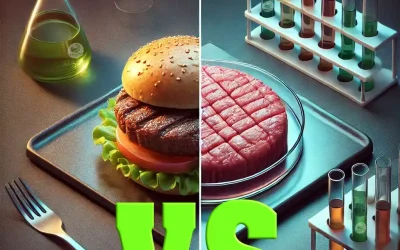
Plant-based meat vs. cultivated meat.
Alternatives to traditional meat: between plant-based and cultivated options. The debate on the future of sustainable food has placed plant-based meat and cultivated meat at the center of the conversation. Both alternatives aim to reduce environmental impact, improve...
What is cultivated leather?
Cultivated leather: a sustainable revolution in the industry. Cultivated leather is an innovative material created from cell cultures in a laboratory, without the need for animal breeding and slaughter. Through advanced biotechnological processes, a product is...

Cultivated pork: Uncommon ethical and sustainable innovation
Uncommon: innovation in cultivated meat for a sustainable future. Uncommon, formerly known as Higher Steaks, is a biotechnology company based in Cambridge, UK, that is revolutionizing the way meat is produced. Founded in 2018 and rebranded in 2023, Uncommon...

Asia-Pacific drives sustainability with cultivated meat.
Asia-Pacific and cultivated meat: A promising future. The Asia-Pacific region is positioning itself as a global leader in the adoption of cultivated meat, thanks to an innovative approach that balances sustainability, technology, and tradition. In a context where meat...
AMPS Innovation: Regulations and advances in cultivated meat in the United States.
What is AMPS Innovation? The Association for Meat, Poultry and Seafood Innovation (AMPS Innovation) is a nonprofit organization that brings together leading food companies dedicated to producing meat, poultry, and seafood directly from animal cells. Its primary...