Ancestral fermentation: The simplest bioreactors in history.
Modern bioreactors, with their advanced technology and sophisticated designs, may seem far removed from the rudimentary practices of our ancestors. However, the essence of these devices, which are now used to produce medicines, food, and biofuels, has its roots in tools as simple as clay vessels.

The first fermenting vessels.
Thousands of years ago, before the science behind fermentation was understood, civilizations used clay jars to transform food and liquids into products with new properties. These first “bioreactors” were used to ferment bread dough, brew beer, and preserve food through natural processes that harnessed microorganisms present in the environment.
These vessels, typically made of clay, were ideal for fermentation due to their porosity, which allowed a certain degree of gas exchange. Although their use was purely empirical, they marked the beginning of a technology that would transform the way humans interact with nature.
The science behind clay.
Clay was not only an accessible material but also offered practical benefits. Its ability to maintain a relatively stable temperature was crucial for the development of microorganisms such as yeasts and bacteria. Additionally, its porous surface helped retain essential nutrients for the fermentation process.
These vessels were used in cultures across the world. In Egypt, for example, they were used for beer fermentation, while in Mesopotamia, they were used to preserve food in brine. Although their purpose varied, the principle remained the same: creating an environment conducive to microbial activity.
From rudimentary to sophisticated.
Over time, the understanding of fermentation processes evolved. What began as empirical observation became a science, and clay vessels were gradually replaced by metal and glass structures with precise controls for temperature, pH, and oxygenation. However, the fundamentals remain unchanged: providing an optimal environment for microorganisms.
Today, modern bioreactors are essential in the production of medicines like insulin, biofuels, and fermented foods. But it is important to remember that it all began with a simple clay vessel—a revolutionary tool in the hands of our ancestors.
A living legacy.
The evolution of bioreactors shows us how simple ideas can lead to extraordinary advancements. While we now have cutting-edge technology, the history of the first fermenting vessels reminds us that innovation often arises from observing and adapting available resources.
The next time you enjoy a craft beer or a piece of fermented bread, think about how this simple principle, born thousands of years ago, is still present in our lives. Today’s bioreactors may be more complex, but their essence remains as simple and remarkable as the ancient clay that started it all.

Is plant-based meat an ultra-processed food?
YES, if we want it to be called plant-based meat. The food industry has developed products that aim to replicate, with remarkable precision, the characteristics of animal meat: its texture, flavor, aroma, and appearance. To achieve this, most plant-based meats...
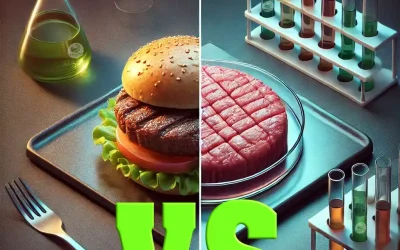
Plant-based meat vs. cultivated meat.
Alternatives to traditional meat: between plant-based and cultivated options. The debate on the future of sustainable food has placed plant-based meat and cultivated meat at the center of the conversation. Both alternatives aim to reduce environmental impact, improve...
What is cultivated leather?
Cultivated leather: a sustainable revolution in the industry. Cultivated leather is an innovative material created from cell cultures in a laboratory, without the need for animal breeding and slaughter. Through advanced biotechnological processes, a product is...

Cultivated pork: Uncommon ethical and sustainable innovation
Uncommon: innovation in cultivated meat for a sustainable future. Uncommon, formerly known as Higher Steaks, is a biotechnology company based in Cambridge, UK, that is revolutionizing the way meat is produced. Founded in 2018 and rebranded in 2023, Uncommon...

What are sweet proteins?
The future of sweeteners: sweet proteins through precision fermentation. Sugar has long been a key ingredient in food, but its impact on health has led to the search for healthier alternatives. Among them, sweet proteins obtained through precision fermentation have...

Asia-Pacific drives sustainability with cultivated meat.
Asia-Pacific and cultivated meat: A promising future. The Asia-Pacific region is positioning itself as a global leader in the adoption of cultivated meat, thanks to an innovative approach that balances sustainability, technology, and tradition. In a context where meat...